Never Stop Being a Student of Your Craft
I've been working as a photographer for many years now, and one thing I've learned is that experience doesn't mean you've reached a point where there's nothing left to learn.
If anything, the longer I stay in photography, the more I realize how much more there is to understand.
It's easy to become comfortable after doing something for years. You develop your own way of working. You know your camera. You know your lighting setups. You know how to solve problems when you're on a shoot. Eventually, a lot of things become almost automatic.
But photography keeps changing.
Cameras change. Software changes. Technology changes. The way people consume images changes. And every year, there are new photographers coming into the industry who are hungry, talented, and willing to learn.
So experience alone isn't enough.
You have to keep learning.
Keeping One Foot Ahead
Photography has always been competitive, but I think it's even more competitive today.
Good equipment has become much more accessible. You can learn almost anything online. Even smartphones are capable of producing images that would have been difficult to imagine years ago.
So simply having a professional camera doesn't separate you from everyone else anymore.
What matters more is what you know, how you see things, how you solve problems, and what you can actually create with whatever equipment is in front of you.
When I say that we should always try to keep one foot ahead, I don't mean that we have to compete with every photographer around us.
I think the better competition is with ourselves.
Am I still improving?
Am I still curious?
Is there something I understand today that I didn't understand last year?
Because it's very easy to become comfortable with what we already know. And once we become too comfortable, that's when we can start falling behind without even realizing it.
The Hardest Part Is Finding the Time
This is probably the part I struggle with the most.
When photography is already your full-time job, studying photography after work isn't always easy.
There are shoots, deadlines, editing, commuting, responsibilities at home, and everything else happening in life. Some days, by the time you finally have a little free time, you just want to switch off.
I completely understand that.
But I've also realized that learning doesn't have to mean sitting down for three or four hours every night.
Sometimes it's just one lesson.
Maybe it's watching something for 30 minutes. Reading about a technique you've always wanted to understand. Trying a different lighting setup. Going back to something you thought you already knew.
Those small sessions still count.
The important thing is that we don't completely stop.
We photographers can easily justify spending money on another lens, another light, another modifier, or another piece of equipment. And I'm guilty of that too.
But sometimes the better investment isn't another piece of gear.
It's knowledge.
Gear eventually becomes old. Cameras get replaced. Software changes. Technology moves forward.
What you learn stays with you.
Going Back to School, in a Way
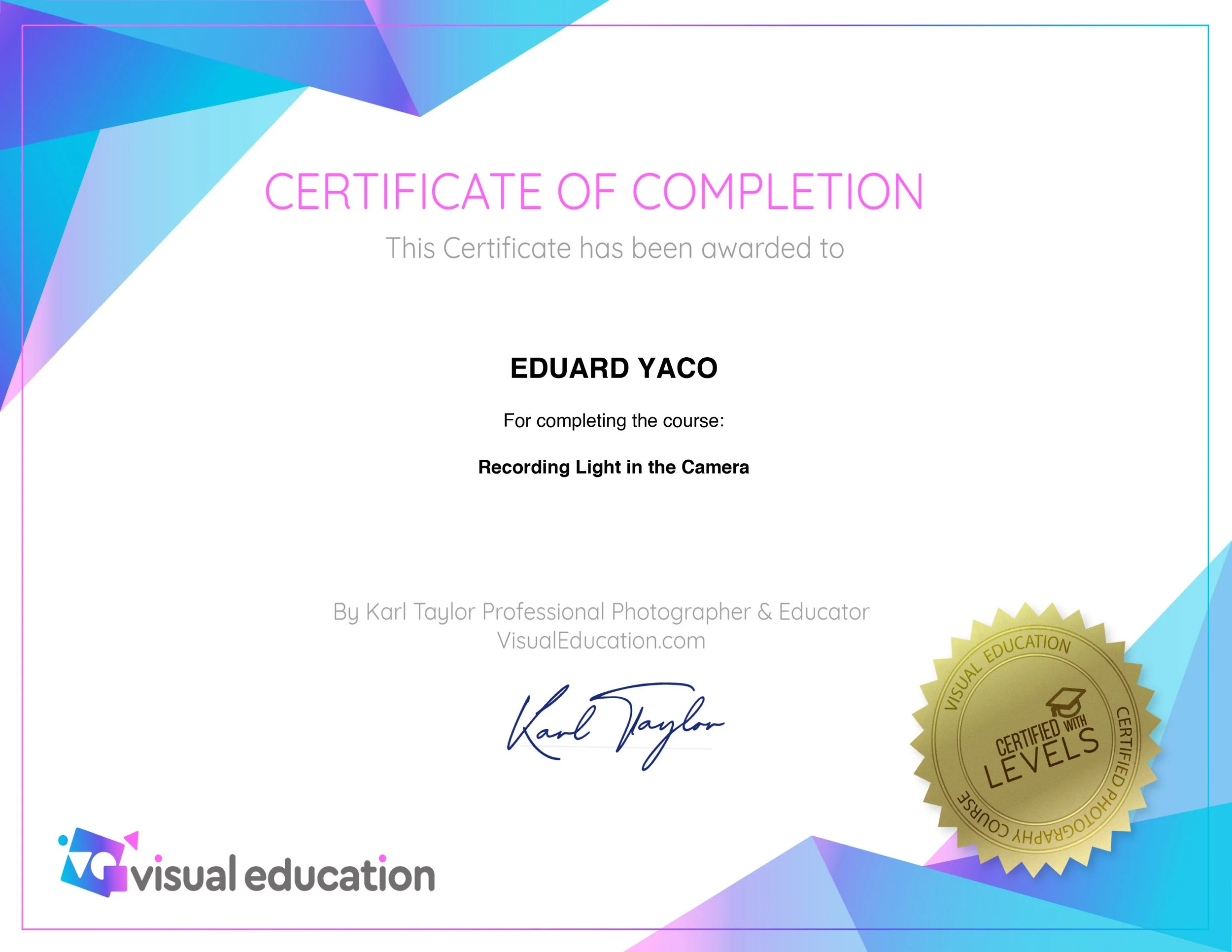
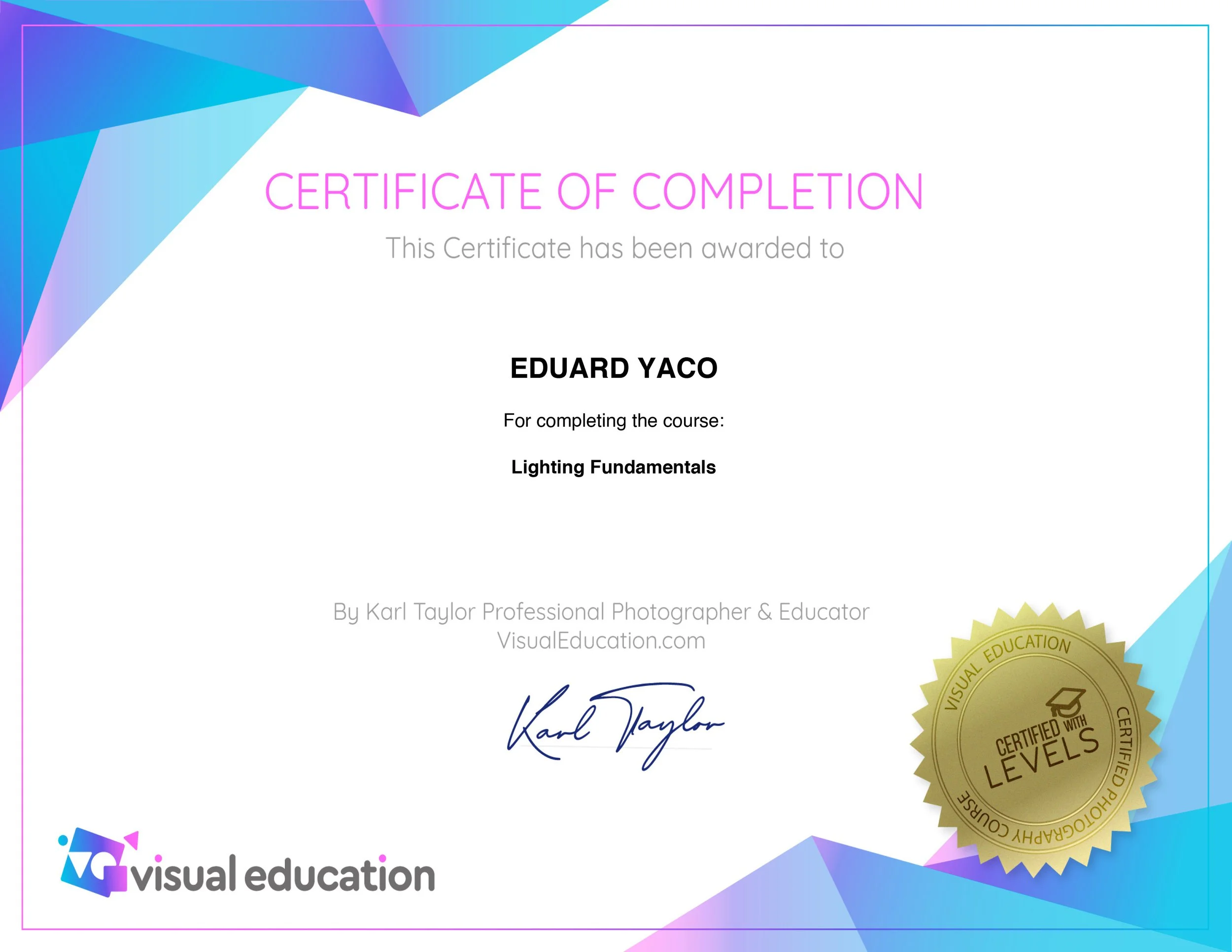
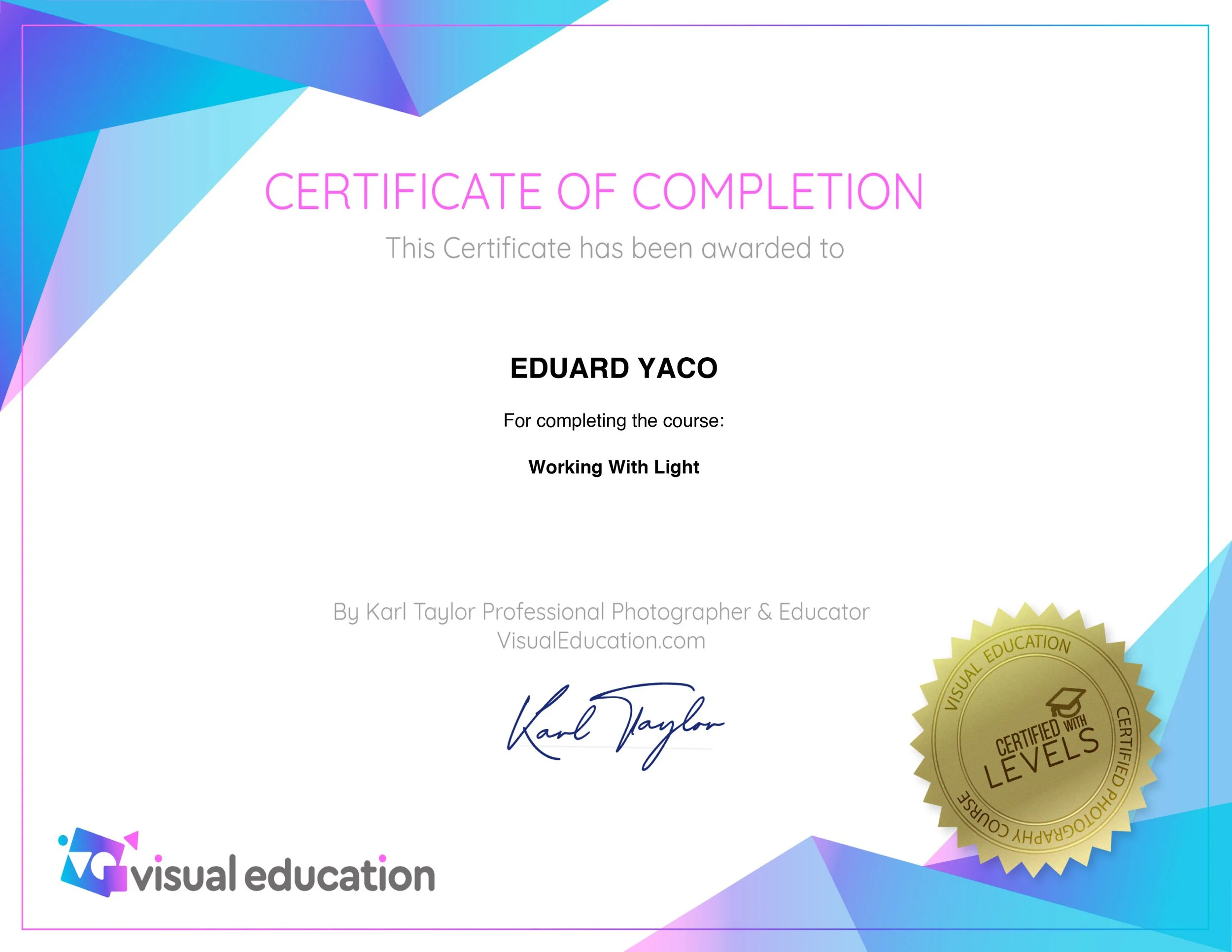
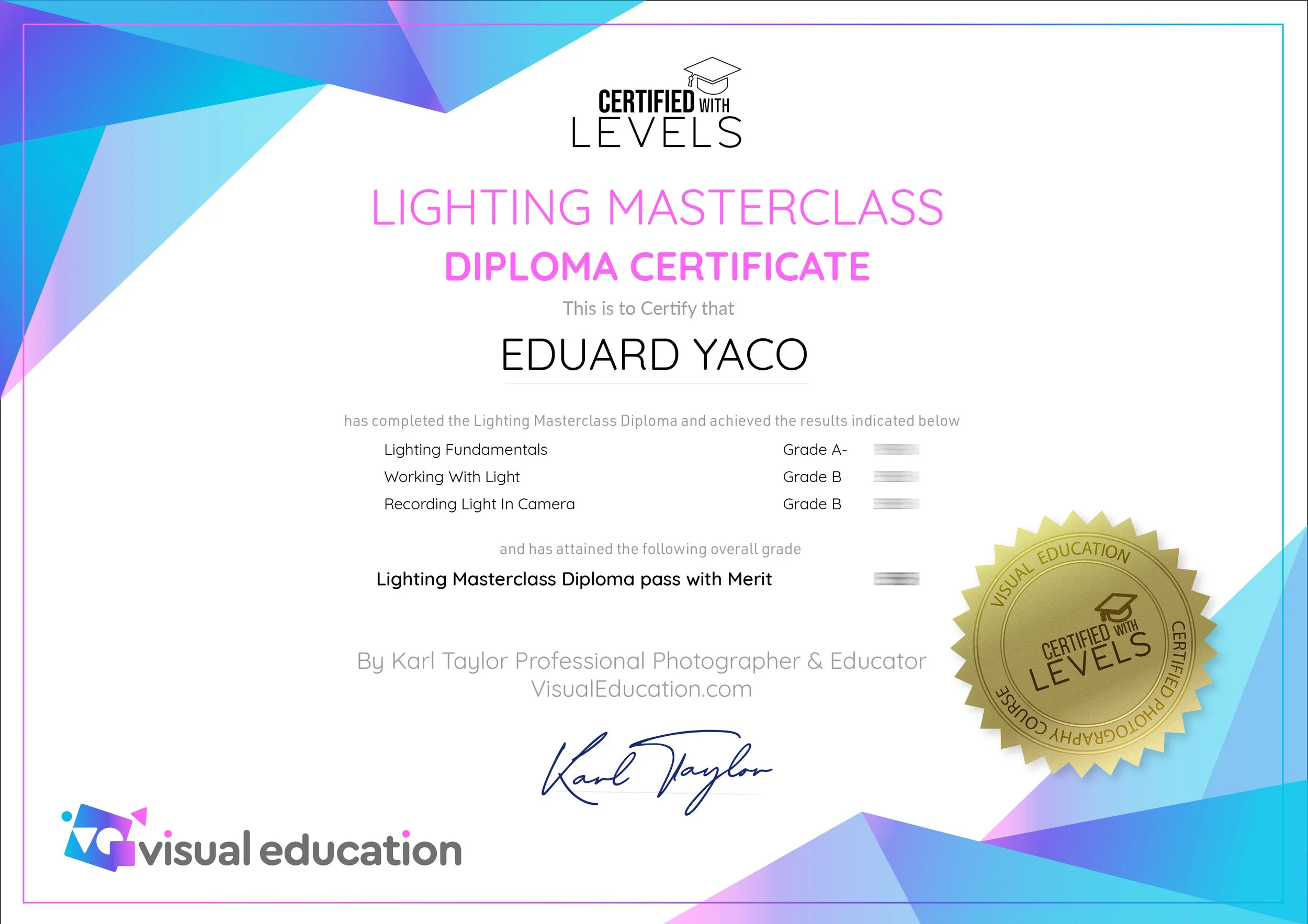
Recently, I completed the Lighting Masterclass Diploma from Visual Education through its Certified with LEVELS program, finishing with an overall Pass with Merit.
Visual Education was founded by professional photographer and educator Karl Taylor, whose work and teaching I've followed for some time. The LEVELS program is a structured learning and certification system where you go through a series of classes and assessments instead of simply watching tutorials and moving on.
For the Lighting Masterclass, I completed three levels:
Lighting Fundamentals — Grade A-
Working With Light — Grade B
Recording Light in the Camera — Grade B
After completing all three, I received the Lighting Masterclass Diploma with Merit.
What I liked about going through these courses wasn't simply receiving another certificate.
It was being reminded of the fundamentals.
Sometimes You Need to Go Back to the Basics
When you've been shooting professionally for a long time, you start doing many things without really thinking about them.
You move a light because you know it needs to move.
You change the angle.
You bring the light closer.
You add diffusion.
You look at the result and immediately know that something isn't right.
Experience teaches you those instincts.
But studying the fundamentals again makes you stop and ask yourself something that we sometimes forget to ask:
Why?
Why does moving the light change the image that way?
Why does the reflection behave like that?
Why does changing the size or distance of a light source affect the result?
Why does something I've been doing for years actually work?
That's what I enjoyed about studying lighting again.
Some of the lessons were things I already knew from years of working behind the camera. But revisiting them gave me a deeper understanding of things that had become almost automatic to me.
And every now and then, you encounter something that makes you think, Ah, so that's why.
I love those moments.
Experience Doesn't Mean You Know Everything
I think one of the easiest mistakes to make after working in an industry for a long time is believing that experience automatically makes further education unnecessary.
I actually think the opposite.
Experience makes learning more interesting.
When you're starting out, you learn a concept and try to imagine how you might use it.
When you've been working for years, you learn the same concept and immediately remember situations you've encountered on actual shoots.
You remember a difficult product.
A lighting problem.
A shoot where something worked beautifully.
Another shoot where you couldn't figure out why something wasn't working.
Suddenly, the theory connects with your own experiences.
That's when learning becomes really valuable.
There's also something healthy about admitting that even after years of doing this professionally, I can still sit down and be a student again.
I don't think we should ever lose that.
Before Buying More Gear, Invest in Yourself
As photographers, we're always tempted by equipment.
There's always another camera coming out.
Another lens.
Another light.
Another modifier.
Something sharper, faster, brighter, smaller, or supposedly better than whatever we're currently using.
And yes, equipment matters. I love good equipment as much as any photographer.
But equipment can only take you so far.
Give someone an expensive light and they still need to understand where to put it.
Give someone an expensive camera and they still need to know what they want to photograph.
Give someone the latest software and they still need to know what they're trying to achieve.
That's why I think investing in knowledge is one of the best investments we can make in ourselves.
A camera can become outdated.
A lens can be replaced.
A computer eventually becomes too slow.
But something you truly understand becomes part of the way you work.
You carry that knowledge with you to the next camera, the next studio, the next assignment, and the next problem you have to solve.
The Certificate Isn't the Finish Line
I'm happy to have completed the Lighting Masterclass and earned the diploma.
Of course I am.
But I don't look at the certificate and think, That's it. I know lighting now.
Photography doesn't work like that.
There will always be something I don't know.
There will always be another technique to try, another photographer to learn from, another mistake to make, and another way of seeing something I've photographed a hundred times before.
And I think that's actually one of the reasons I've stayed interested in photography for so long.
You never really finish learning it.
The certificate is nice to have, but for me, what matters more is what happened while earning it—the hours spent studying, revisiting things I thought I knew, understanding them better, and adding something new to what years of experience had already taught me.
That's the real value.
No matter what field we've chosen, especially if it's something we're passionate about, I think we owe it to ourselves to keep working on it.
Life gets busy. Work gets tiring. Sometimes we genuinely don't have much time left in the day.
But find a little time when you can.
Watch one lesson.
Read a few pages.
Try something different.
Ask questions.
Make mistakes.
Go back to the basics.
Stay curious.
Because in a competitive industry, we can't control how talented the next photographer will be or how quickly technology will change.
What we can control is whether we're still willing to grow.
After all these years behind the camera, I'm still learning.
And I hope I never reach the point where I think I don't need to anymore.
Ancora Imparo.
I am still learning.